|
3 Day Geomagnetic Forecast
|
|
May 12 |
May 13 |
May 14
|
|
8-9 (G5)
|
7 (G3)
|
5 (G1)
|
|
Max Kp |
|
M-Lat
55%
H-Lat
95% |
M-Lat
55%
H-Lat
95% |
M-Lat
30%
H-Lat
70% |
|
Probabilities |
|
Latest SWPC Forecast (@ 00:30 + 12:30 UTC)

|
Geomagnetic Field and Aurora
|
Past 24 Hours:
Storm (G5)
|
|
|
|


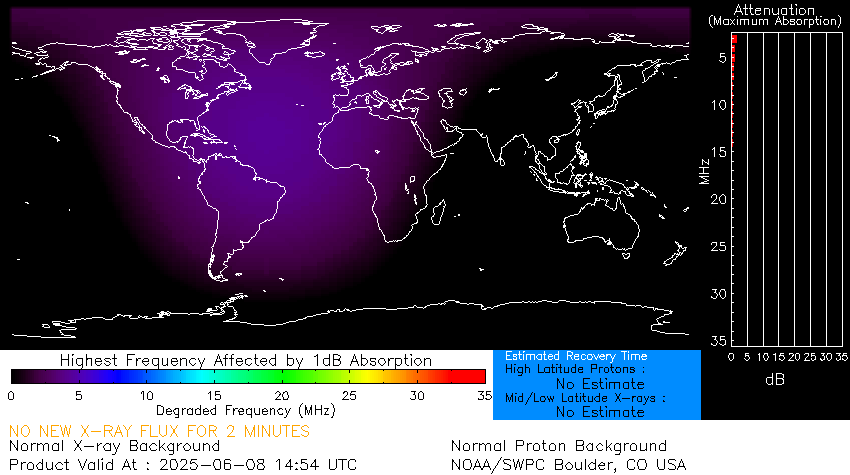
Global D-LAYER Absorption
| |
Current Solar Flare Threat
|
C-Flare: 99%
|
M-Flare: 95%
|
|
X-Flare: 75%
|
Proton: 99%
|

|
|
Latest Space Weather News
|

|
Another Possible Incoming Shock Detected
| |
May 12, 2024 @ 09:30 UTC
|
|
The geomagnetic field returned to quieter levels, but for how long? DSCOVR solar wind speed data just showed a jump from 812 km/s to just over 900 km/s which may be a sign another expected shockwave is about to pass Earth. A geomagnetic storm watch remains in effect for the next 24-48 hours.
|
Extreme Storm Subsides For Now
| |
May 12, 2024 @ 02:00 UTC
|
|
While the solar wind speed remains very high just above 900 km/s, the Bz/IMF component is closer to neutral territory and has been in this state for several hours. This is suppressing geomagnetic activity which currently sits at the moderate (G2) storm threshold. A severe (G4) to extreme (G5) geomagnetic storm watch remains in effect for the next 24 hours as additional shockwaves are expected to pass Earth. Aurora sky watchers should remain alert.
Below is a nice aurora photo shared by my friend Vimala Madhusoothanan. She captured the display last night from Simcoe, Ontario. Great job!

More great imagery by Chuck Vaughn from Arizona, Mark Mueller from Germany and Drew Brashler from Lexington, Kentucky.
|
G5 Storm and High Activity Continues
| |
May 11, 2024 @ 12:00 UTC
|
|
What a time to follow space weather. Our geomagnetic field continues to feel the effects of a major CME impact. A severe (G4) to Extreme (G5) geomagnetic storm remains in progress. Currently the solar wind speed is above 800 km/s and the Bz component is south (-22nT). Storming should persist today and visible aurora could be visible for the second night in a row.
Below image shows beautiful pink aurora last night captured from North Carolina by Nate Lesher. Thanks for sharing!

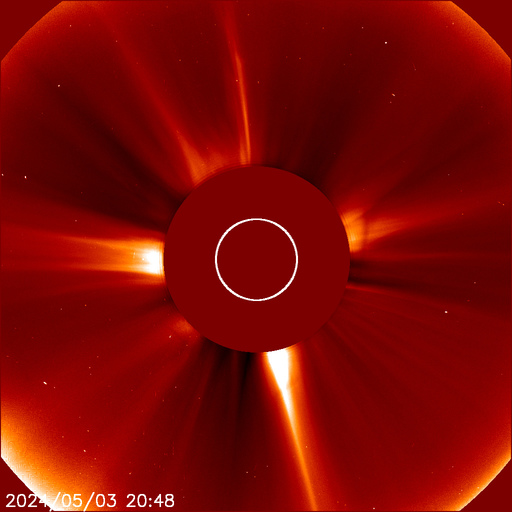
A coronal mass ejection (CME) was produced by the X5.8 solar flare early Saturday morning and as expected, the bulk of plasma is heading to the west. A fainter Earth directed component is still visible and this could pass our planet within 72 hours. There was another proton increase to the moderate (S2) radiation storm threshold and this is related to the X5 event.

And finally, AR 3664 just produced its seventh X-Flare. The latest event measured X1.5 at 11:44 UTC (May 11). Further details regarding that blast will be added whenever necessary.

|
X5.8 Solar Flare
| |
May 11, 2024 @ 01:45 UTC (UPDATED)
|
|
AR 3664 is the gift that just keeps on giving. While everybody around the world has been paying attention to the Extreme (G5) geomagnetic storm and vivid aurora displays, the active sunspot region decided to produce yet another strong solar flare. The latest was an X5.89 event at 01:23 UTC (May 11). Coronal dimming is evident and although the majority of plasma should be directed to the west, an Earth directed component is still very likely. It seems that good nights are ahead if you are an aurora chaser!
Click HERE for a video.

|
Extreme (G5) Storm Reached / Widespread Aurora
| |
May 10, 2024 @ 21:45 UTC (UPDATED)
|
|
A severe geomagnetic storm continues with the Kp index nearing the Extreme (G5) storm threshold. Aurora is happening now across many locations even at lower latitudes where it is dark outside.
For ham radio operators, 6 meters is currently jam packed with stations working via the aurora with very strong and distorted signals. Antennas to the north!
Extreme (G5) Storm: For the first time since the great Halloween Storm of 2003, the Extreme (G5) Geomagnetic Storm threshold has been reached!
ALERT: Geomagnetic K-index of 9
Threshold Reached: 2024 May 10 2254 UTC
Synoptic Period: 2100-2400 UTC
Active Warning: Yes
NOAA Scale: G5 - Extreme
Have aurora photos you would like to share?
Please send to kevin@solarcycle24.com

Aurora from Czech Republic courtesy of Martin Pavelek.
Thank you for sharing!

|
Severe (G4) Geomagnetic Storm in Progress
| |
May 10, 2024 @ 16:50 UTC (UPDATED)
|
|
One, or perhaps a combination of at least two coronal mass ejections just reached both the ACE and DSCOVR spacecrafts. The solar wind is fairly high nearing 700 km/s. A passage past our planet should take place within the next 45 minutes. Stay tuned.
Strong CME Impact:
A geomagnetic sudden impulse measuring 108 nT was detected around 17:00 UTC by ground based magnetometers. A geomagnetic storm is already in progress and reached the Severe (G4) threshold. The solar wind speed is above 700 km/s and the Bz component of the interplanetary magnetic field is shifting wildly. More to follow.
ALERT: Geomagnetic K-index of 8, 9-
Threshold Reached: 2024 May 10 1739 UTC
Synoptic Period: 1500-1800 UTC
Active Warning: Yes
NOAA Scale: G4 - Severe

SUMMARY: Geomagnetic Sudden Impulse
Observed: 2024 May 10 1645 UTC
Deviation: 108 nT
Station: Boulder

|
X3.9 Solar Flare / Radiation Storm
| |
May 10, 2024 @ 08:50 UTC (UPDATED)
|
|
The largest solar flare yet produced by AR 3664 was just observed at 06:54 UTC. This X3.9 blast is associated with a Type II radio emission with an estimated velocity of 1248 km/s, along with a 10cm radio burst (TenFlare) measuring 900 SFU and lasting 16 minutes. A coronal mass ejection (CME) is now becoming visible and it appears the main bulk is heading to the west, but there will likely still be an Earth directed component. More to follow.
Click HERE for video.
Also click HERE for a summary video of the past few days.
Radiation Storm: The minor (S1) radiation storm threshold was reached at 13:35 UTC (May 10). This is possibly related to X3.9 flare this morning, or can also be due to a combination of all previous eruptions nearing Earth.

|
|
|
|


 9
9  8
8